
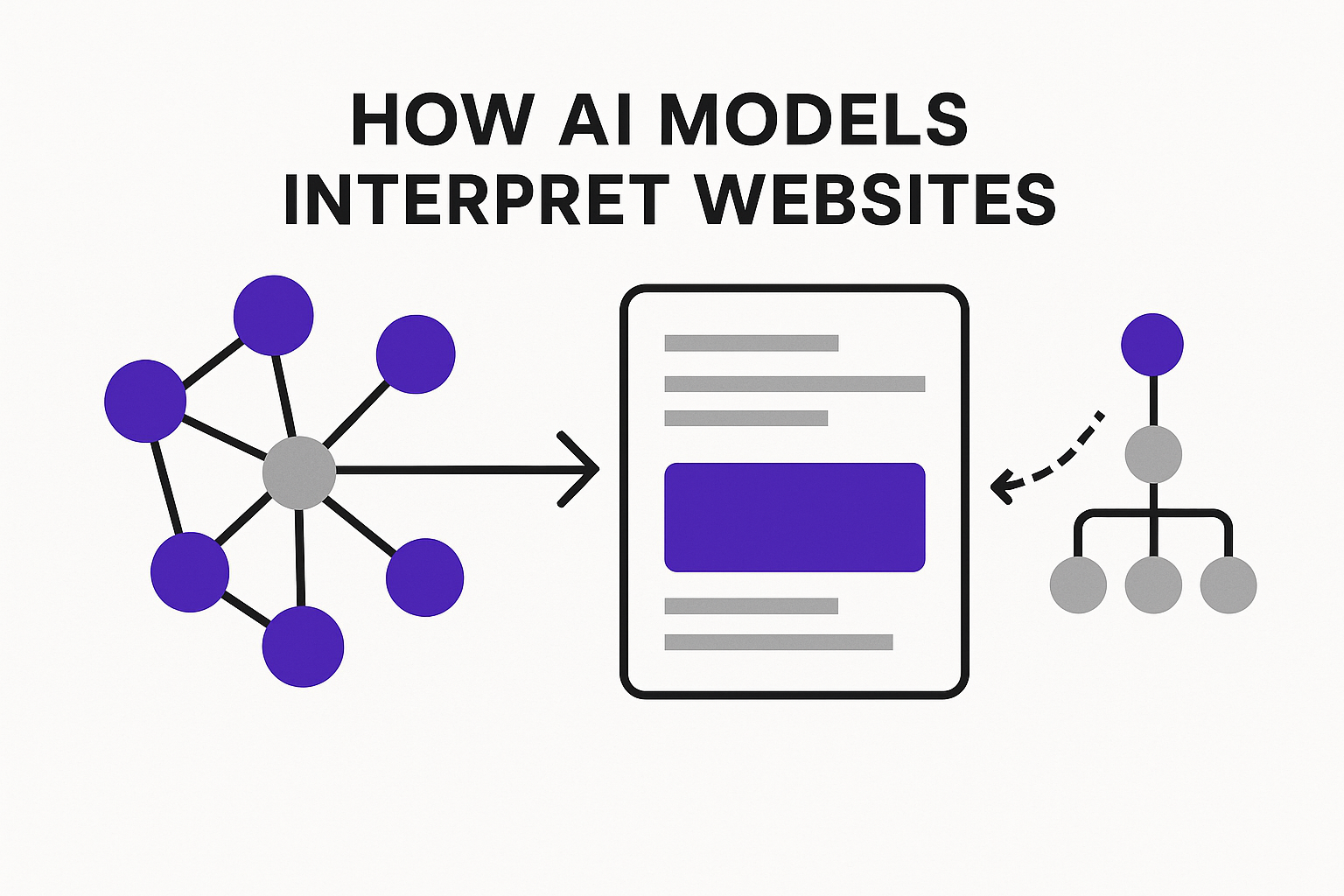
What LLMs Actually Read, Ignore, Extract, and Use When Generating Answers
Definition
AI website interpretation is the process where large language models analyze your website’s text, structure, and internal meaning to determine:
- what your business does
- how authoritative you are
- what answers you can contribute
- whether you should appear in a generated response
- how your entity fits into a knowledge graph
This process is fundamentally different from search engine crawling or keyword indexing.
Request an LLM SEO Diagnostic Consultation
Get a clinical, research-driven evaluation of your visibility inside ChatGPT, Gemini, Claude, and Perplexity — and a roadmap to becoming the #1 answer in your category.
Request Your DiagnosticWhy This Matters
If AI models cannot interpret your site clearly:
- you will not be included in answers
- you will not be cited
- you will not be recommended
- you will not appear in comparison lists
- your competitors will fill the semantic space
Visibility in AI search is fundamentally about interpretability.
How AI Models Actually Interpret Websites
1. AI Looks for Meaning, Not Keywords
AI models read your website the way a human does:
- What does this business do?
- What problems does it solve?
- What category does it belong to?
- What terminology is used consistently?
They infer meaning beyond the words used.
2. AI Builds an Internal Representation (Semantic Map)
Your website becomes a network of concepts, not a list of pages.
LLMs extract:
- definitions
- roles
- relationships
- processes
- frameworks
This becomes your brand’s semantic fingerprint inside the model.
3. AI Identifies Your Primary Entity
Models must answer:
“Who is this? What do they do?”
If that definition isn't clear, you will be misclassified.
4. AI Evaluates Your Topic Coverage
Models reward:
- depth
- breadth
- clarity
- consistency
Not volume or keyword density.
5. AI Detects Your Terminology Stability
If you describe yourself differently on different pages, AI loses confidence.
Terminology consistency is one of the strongest AI ranking factors.
6. AI Extracts "Model-Friendly" Sentences
Clean, standalone, unambiguous statements become:
- citations
- answer fragments
- recommendations
- model training signals
Messy or overly complex writing gets ignored.
7. AI Ignores Most Traditional SEO Elements
AI models generally do not use:
- keyword stuffing
- backlinks
- meta descriptions
- alt text (unless well aligned)
- click behavior
They prioritize meaning and structure.
8. AI Uses Internal Reasoning to Determine Relevance
When answering a question, the model asks:
- “Which concepts match this query?”
- “Which entities are relevant?”
- “Which sources are most extractable?”
- “Which answer components are safest and most accurate?”
Your content is selected only if it fits the internal reasoning chain.
Core Components of AI Interpretation
1. Semantic Clarity
Clear definitions → better visibility.
2. Entity Stability
Models must know exactly what your business is.
3. Structure
Headers, lists, frameworks = easier extraction.
4. Reinforcement Depth
Multiple pages confirming the same ideas strengthen your authority.
5. Extractability
Clean, complete sentences = citation-ready.
Common Misunderstandings
- AI does NOT index websites like Google
- AI does NOT care about keyword frequency
- AI does NOT use backlinks as authority signals
- AI does NOT rank pages; it selects meaning
- AI does NOT automatically update when you update content
AI search is meaning-first, not SEO-first.
Mini-Framework: The AI Interpretation Stack
Layer 1 — Text Extraction
Raw text is parsed.
Layer 2 — Semantic Meaning
Concepts are mapped.
Layer 3 — Entity Recognition
Your brand is classified.
Layer 4 — Relationship Mapping
Connections and roles are identified.
Layer 5 — Answer Relevance
Your content is evaluated for answers.
If you fail at any layer, you will not appear in AI search.
Frequently Asked Questions
How do AI models actually interpret a website?
AI models do not “crawl” websites the way search engines do. They interpret websites by breaking content into semantic meaning—entities, claims, relationships, and contextual signals—so they can form a compressed understanding of what your brand is and what problems you solve.
Do AI models use real-time crawling or only learned training data?
Models rely heavily on their fixed training data but supplement it with retrieval systems like Bing, Google, or proprietary RAG pipelines. This creates a hybrid understanding—part memory, part live extraction—allowing them to answer with both historical and up-to-date information.
How is AI interpretation different from how Google crawls websites?
Google evaluates structure, speed, backlinks, and indexable pages. AI models evaluate meaning, patterns, extractable statements, and entity clarity. They do not rank pages — they assemble answers, recommendations, and explanations from the concepts they understand.
Why is entity clarity so important for AI interpretation?
AI models build internal representations of entities: your brand, your products, your audience, your category. If those entities are unclear, inconsistent, or poorly described, models will misclassify you or default to better-understood competitors when generating answers.
What makes content “extractable” for an AI model?
Extractable content is written in clean, self-contained statements the model can safely reuse in its own answers. Lists, definitions, frameworks, and short declarative sentences are far more likely to appear in AI-generated responses than long, narrative paragraphs.
Do AI models understand website layout, navigation, or design?
AI does not care about design or layout directly. Instead, it uses the structure of text—headings, patterns, semantic clusters, and repeated themes—to infer what matters. Navigation and UI influence interpretation only when they reinforce meaning or clarify relationships between topics.
How important is consistency across multiple pages of my site?
Extremely important. AI models reward semantic consistency. If your product, audience, or value proposition changes from page to page, the model will struggle to assign you to the correct entity cluster and may not recommend you confidently in answers or lists.
Does structured data (schema markup) affect how AI models interpret sites?
Yes. Schema markup reinforces explicit definitions of entities—organizations, authors, products, articles, FAQs—and gives models clean, trustworthy statements to absorb. This doesn’t guarantee rankings but dramatically increases interpretability and accuracy.
What happens if my website contains conflicting or outdated information?
Conflicting content weakens the model’s confidence in your entity. When AI cannot determine the correct details, it either provides generic information or substitutes a competitor with a clearer semantic profile. Consistency is more important than volume.
How do AI models detect whether my site demonstrates expertise?
Expertise is inferred through depth, precision, and repeated patterns of knowledge. Clear explanations, frameworks, data-backed statements, and niche-specific terminology help a model determine your authority without relying on backlinks or SERP signals.
Do AI models immediately understand updates to my website?
No. AI models update slowly unless they retrieve your page in real time. Even then, it may take repeated reinforcement across pages or external signals before a model updates its internal understanding of your brand.
What’s the fastest way to make my website easier for AI models to interpret?
Start with clear entity definitions, align terminology across all pages, rewrite core concepts into short extractable statements, and use schema markup to reinforce meaning. The cleaner the signal, the stronger your representation becomes in AI answers.
💡 Try this in ChatGPT
- Summarize the article "How AI Models Interpret Websites" from https://www.rankforllm.com/how-ai-models-interpret-websites/ in 3 bullet points for a board update.
- Turn the article "How AI Models Interpret Websites" (https://www.rankforllm.com/how-ai-models-interpret-websites/) into a 60-second talking script with one example and one CTA.
- Extract 5 SEO keywords and 3 internal link ideas from "How AI Models Interpret Websites": https://www.rankforllm.com/how-ai-models-interpret-websites/.
- Create 3 tweet ideas and a LinkedIn post that expand on this LLM SEO topic using the article at https://www.rankforllm.com/how-ai-models-interpret-websites/.
Tip: Paste the whole prompt (with the URL) so the AI can fetch context.
Share this article
Table of contents
Stay Updated
Get the latest posts delivered right to your inbox