
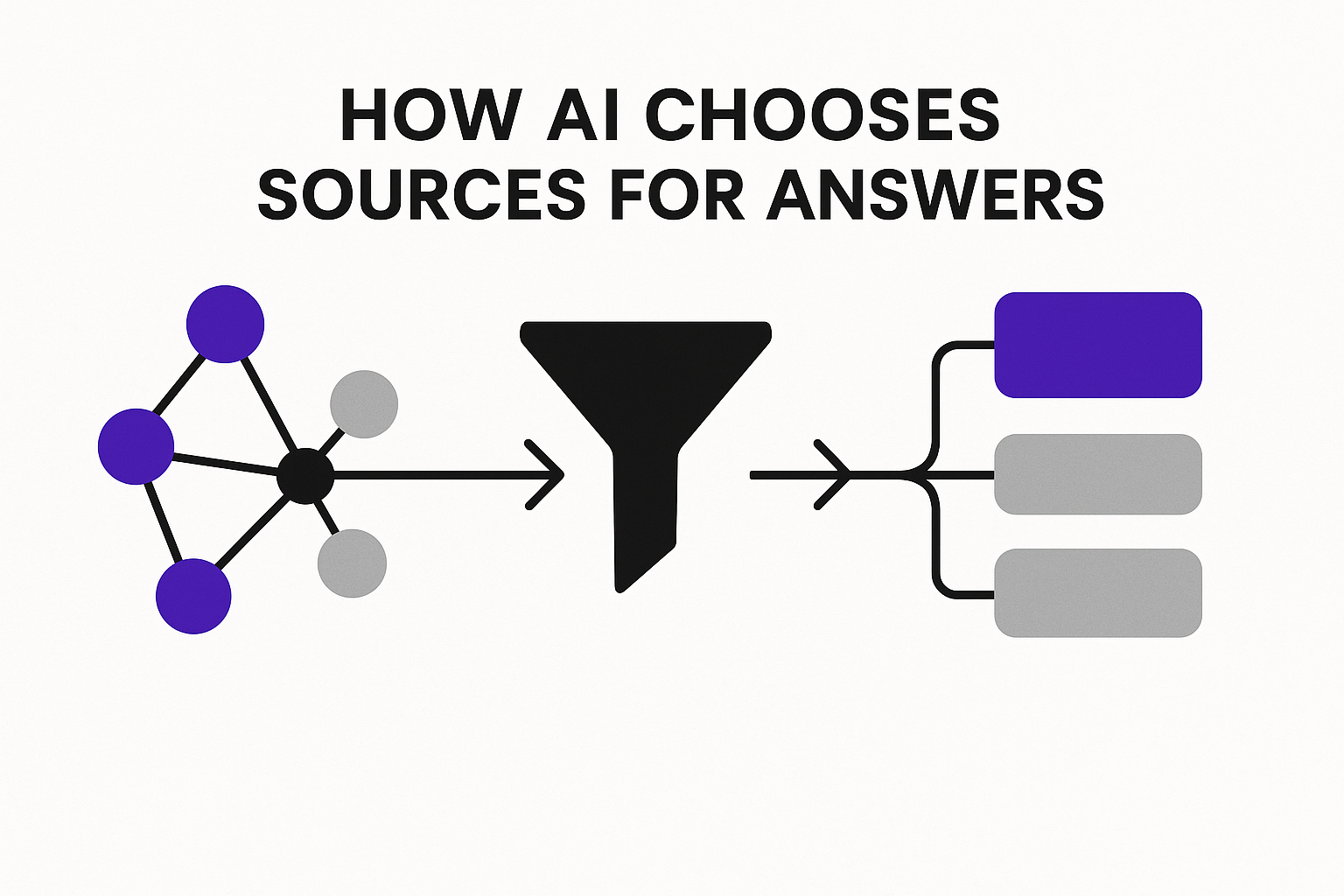
What Determines Whether Your Content Is Included, Ignored, or Replaced
Definition
Source selection is the process where AI models determine which pieces of content to use when generating an answer. This includes:
- internal knowledge
- retrieved website content
- verified entities
- high-clarity explanations
- consistent, trustworthy sources
Models do not “rank” sources. They choose whichever sources best support the answer being generated.
Request an LLM SEO Diagnostic Consultation
Get a clinical, research-driven evaluation of your visibility inside ChatGPT, Gemini, Claude, and Perplexity — and a roadmap to becoming the #1 answer in your category.
Request Your DiagnosticWhy This Matters
If your content is not selected:
- you will not appear in AI answers
- you will not be cited
- you will not be recommended
- you lose visibility and authority
- you lose commercial opportunities
Being selected as a source is one of the highest-value outcomes in AI search.
How AI Actually Chooses Sources
1. Semantic Relevance Is the First Filter
Models ask:
“Does this source match the meaning of the query?”
Not keywords.
Not metadata.
Meaning.
If the model cannot match your content semantically, it will not use it.
2. Models Prefer Clear, Extractable Statements
AI chooses content that can be easily lifted into an answer:
- clean definitions
- structured explanations
- step-by-step logic
- unambiguous sentences
- complete concepts
Messy prose is ignored.
3. Consistency Across Pages Increases Trust
Models analyze:
- terminology stability
- reinforcement depth
- definition alignment
If your site contradicts itself, your trust score drops.
4. Authority Signals Are Semantic, Not SEO-Based
Models measure authority by:
- clarity
- correctness
- conceptual coherence
- consistency across multiple pages
- domain specialization
Backlinks and keyword density have no impact.
5. AI Uses Internal Knowledge Before External Sources
LLMs check:
- What they already know
- What aligns with stored representations
- What external sources reinforce that knowledge
Your content must fit the model’s existing understanding.
6. Models Avoid Sources That Introduce Risk
AI is cautious. It avoids:
- unclear entities
- ambiguous definitions
- inconsistent value propositions
- poorly structured explanations
- contradictory content
Risky content is excluded entirely.
7. Models Prefer Canonical Definitions
If your page provides a clean, generalizable definition, the model is far more likely to use it.
This is why your first paragraph and TL;DR matter so much.
8. Trustworthiness Is Evaluated Conceptually, Not Technically
AI asks:
- “Does this page sound credible?”
- “Is it consistent with other trusted sources?”
- “Is it structured like high-quality reference content?”
Your writing style influences trust.
Core Components of Source Selection
1. Relevance
Does your content match the user’s intent?
2. Clarity
Is the meaning easy to interpret?
3. Extractability
Can the AI lift complete, accurate statements?
4. Consistency
Does your content reinforce itself across pages?
5. Confidence
Does the model feel safe using you as a source?
Common Misunderstandings
- AI does not use backlinks to pick sources
- High Google rankings do not influence source selection
- Long content does not improve extractability
- Metadata rarely impacts AI retrieval
- Updating content does not instantly update AI knowledge
- AI will not choose your content if your value prop is unclear
You must optimize for semantic clarity, not SEO trickery.
Mini-Framework: The Source Selection Triad
1. Meaning Match
Your content aligns with the user’s intent.
2. Conceptual Precision
Your statements are unambiguous and complete.
3. Structural Extractability
Your content is formatted for AI to reuse effortlessly.
When these three align, you consistently appear in answers.
Frequently Asked Questions
How do AI models choose which sources to use when generating an answer?
AI models select sources based on semantic relevance, clarity of claims, entity confidence, and the model’s internal understanding of authority. They pull from training data, retrieval systems, and structured content that cleanly defines concepts and relationships.
What’s the difference between training-data sources and real-time retrieved sources?
Training data shapes a model’s baseline knowledge, including its understanding of entities, facts, and patterns. Retrieval systems fetch current, authoritative content at answer time. AI blends these two to generate responses that feel both knowledgeable and up to date.
What signals make a source appear authoritative to an AI model?
Models value clarity, stability, and precision. Cleanly defined entities, consistent terminology, extractable statements, topic depth, and strong semantic alignment across pages all help a model treat your site as an authoritative source.
Do backlinks influence which sources AI models choose?
No. Backlinks help traditional search engines rank pages but do not directly influence how LLMs choose sources. AI relies on meaning, clarity, extractability, and consistency, not link-based authority signals.
Why does extractability matter when AI selects sources for answers?
Models prefer sources that contain self-contained statements they can reuse directly in answers. Definitions, lists, frameworks, and clear explanations increase the likelihood that your content appears inside generated responses.
Does inconsistent messaging reduce the chances of being used as a source?
Yes. Inconsistency weakens entity confidence. If your explanations or terminology shift across pages, models lose certainty and may choose a competitor whose content offers a clearer, more stable signal.
What role does semantic alignment play in source selection?
Semantic alignment—how consistently your pages reinforce the same ideas, terminology, and entities—helps the model understand your domain expertise. The tighter the alignment, the more likely you are to be included in AI answers.
Can AI models be biased toward certain types of sources?
Yes. Models often lean toward content formats that provide clear, structured meaning — authoritative guides, educational resources, definitions, and high-quality informational pages. They also favor well-established entities that appear frequently in training data.
When do AI models pull from real-time sources instead of memory?
Models use real-time retrieval when a question requires current information, niche details, or verification. If your site has strong entity clarity and extractable content, retrieval systems are more likely to elevate your pages as answer-time sources.
How can I increase how often AI models cite or reference my content?
Strengthen semantic clarity, standardize terminology, embed extractable statements, and expand high-authority topic clusters. Models cite sources they understand deeply and trust to fill conceptual gaps during answer generation.
What determines whether an AI model feels confident recommending my brand?
Confidence comes from repeated, reinforced signals across multiple pages. Clear definitions of who you are, whom you serve, and what you offer help the model place you correctly in its internal knowledge graph, making you eligible for recommendations and comparisons.
What practical steps can I take to become a preferred AI source in my category?
Define your core entities clearly, create extractable explanations, build deep topic clusters, remove contradictory messaging, improve cross-page consistency, and use schema markup. The goal is to make your content the easiest and safest option for the model to include in answers.
💡 Try this in ChatGPT
- Summarize the article "How AI Chooses Sources for Answers" from https://www.rankforllm.com/how-ai-chooses-sources-for-answers/ in 3 bullet points for a board update.
- Turn the article "How AI Chooses Sources for Answers" (https://www.rankforllm.com/how-ai-chooses-sources-for-answers/) into a 60-second talking script with one example and one CTA.
- Extract 5 SEO keywords and 3 internal link ideas from "How AI Chooses Sources for Answers": https://www.rankforllm.com/how-ai-chooses-sources-for-answers/.
- Create 3 tweet ideas and a LinkedIn post that expand on this LLM SEO topic using the article at https://www.rankforllm.com/how-ai-chooses-sources-for-answers/.
Tip: Paste the whole prompt (with the URL) so the AI can fetch context.
Share this article
Table of contents
Create Your Auction
Raise 40% more with smart bidding tools