
How AI Models Understand, Classify, and Evaluate Your Business Using Entities Instead of Keywords
Definition
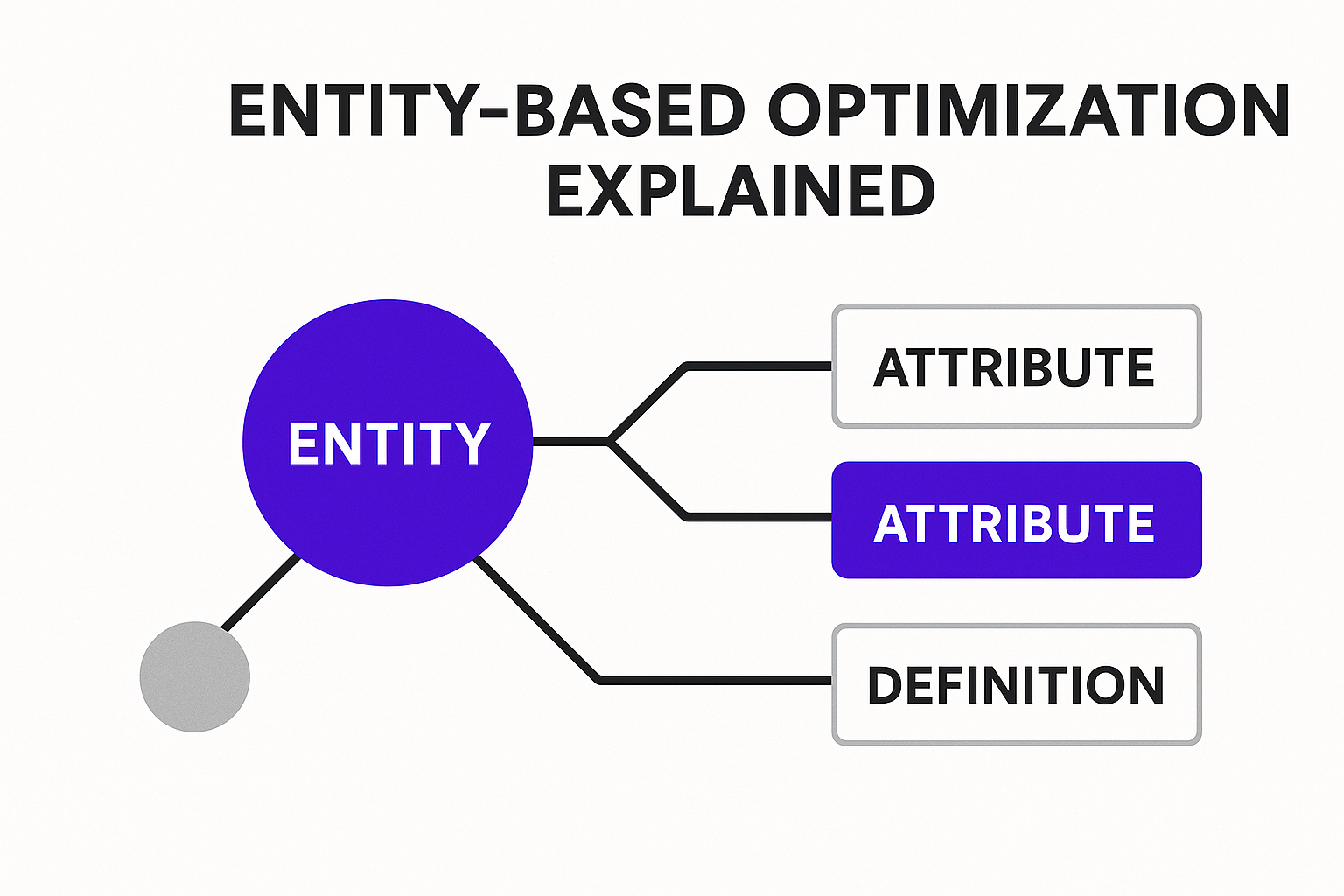
Entity-based optimization is the practice of making your business or concept understandable to AI models as a clearly defined entity with stable attributes, relationships, and categories.
An entity can be:
- a business
- a product
- a service
- a person
- a framework
- a process
AI models rely on entity clarity to select sources, generate answers, and make recommendations.
For more on how AI interprets your site, see:
How AI Models Interpret Websites
Request an LLM SEO Diagnostic Consultation
Get a clinical, research-driven evaluation of your visibility inside ChatGPT, Gemini, Claude, and Perplexity — and a roadmap to becoming the #1 answer in your category.
Request Your DiagnosticWhy Entity Optimization Matters in LLM SEO
1. AI must understand you before it can trust you.
If your definition is unclear, you won’t appear in answers or citations.
2. AI evaluates meaning, not keyword patterns.
Entity clarity influences nearly every LLM SEO pillar.
3. Stability strengthens your semantic identity.
Inconsistent definitions weaken trust across models.
To understand AI trust signals, see:
What Counts as Authority in LLM SEO
How AI Models Build Entities
AI models extract:
- your definitions
- your terminology
- your category
- your relationships
- your attributes
Entities are built from:
1. Name — What is this entity called?
2. Definition — What is it?
3. Attributes — What describes it?
4. Relationships — How does it connect to other concepts?
5. Category — What semantic group does it belong to?
If your site does not make these clear, the model will guess incorrectly.
Key Components of Entity-Based Optimization
1. Clear Definitions
AI prefers definitions that are:
- short
- declarative
- unambiguous
- extractable
Example of a liftable definition:
“An entity is a distinct, definable concept that AI models can classify.”
2. Terminology Stability
Your service must be described the same way—across all pages.
Changing synonyms weakens semantic identity.
For how AI uses definitions, see:
How AI Uses Canonical Definitions
3. Reinforcement Across Pages
Multiple pages need to reinforce:
- the same definitions
- the same concepts
- the same attributes
This is one reason Pillar #1 includes 25 supporting articles.
4. Internal Linking That Reinforces Identity
Internal links behave like semantic signals.
For example, linking between:
reinforces your domain authority.
5. Extractable Sentences
Models favor:
- standalone explanations
- list-based reasoning
- clean definition statements
- stepwise frameworks
These sentences become part of answer generation.
6. Consistent Entity Attributes
AI expects your business to appear as one stable concept.
Inconsistencies cause:
- entity drift
- misclassification
- visibility loss
Common Misunderstandings
- Keywords do not create entities
- Backlinks do not strengthen entity clarity
- Long content does not improve entity formation
- Updated content does not instantly update AI models
- AI will not infer your identity if you don’t define it clearly
Entity optimization is intentional and structured.
Mini-Framework: The Entity Clarity Checklist
1. Can AI summarize your business in one sentence?
If not, you're invisible.
2. Do you use stable definitions across all pages?
Consistency = authority.
3. Do key pages reinforce each other?
Repetition stabilizes classification.
4. Are your explanations extractable?
If AI cannot quote you, it will not rank you.
5. Do internal links strengthen your identity?
Links shape semantic context.
Frequently Asked Questions
What is entity-based optimization in SEO?
Entity-based optimization is the practice of optimizing for people, brands, products, and concepts instead of individual keywords. You focus on clearly defining who you are, what you offer, and how different ideas relate, so search engines and AI models can understand and reuse your information accurately.
How is entity-based optimization different from traditional keyword-based SEO?
Keyword SEO tries to match exact phrases and search volumes. Entity-based optimization focuses on meaning, relationships, and context. Instead of asking “What keyword should I rank for?” you ask “How do I help systems confidently understand my brand and category so they can recommend me in many related queries?”
Why is entity-based optimization so important for LLM SEO?
LLMs answer questions by reasoning about entities and their relationships, not by counting keywords. When your entities are clear and consistently defined, models can recognize you as a relevant solution, include you in lists and comparisons, and reuse your explanations inside generated answers.
What are examples of entities I should define on my website?
Typical entities include your company, founder, products or services, target audiences, core frameworks, geographic focus, and key problems you solve. Each of these should have clear, repeatable definitions that show up consistently across your content.
How do I identify which entities matter most for my business?
Start with your core: brand name, flagship products, primary audience, and signature frameworks. Then map the questions customers ask before buying. The concepts that show up repeatedly in those questions are the entities you should define, reinforce, and structure across your site.
How does schema markup support entity-based optimization?
Schema markup lets you label entities explicitly—Organization, Person, Product, Article, FAQ, and more. This adds a machine-readable layer that reinforces who and what you are, helping search engines and AI models connect your content to the right entities in their knowledge graphs.
How does internal linking affect entity-based optimization?
Internal links connect related entities and topics so systems can see how ideas fit together. When you consistently link supporting articles back to a main entity page using stable anchor language, you create a strong semantic cluster that reinforces your authority on that subject.
What are “extractable” entity statements and why do they matter?
Extractable entity statements are short, self-contained sentences that clearly define who you are and what you do. LLMs can safely copy these into answers. For example: “RankForLLM is an LLM SEO lab that helps brands become the default answer in AI search.” These statements make it easier for models to describe you correctly.
What are common mistakes people make with entity-based optimization?
Common mistakes include changing how you describe your offer on every page, using different names for the same product, burying your core definitions deep in long paragraphs, and creating content that never clearly states who you are or which audience you serve.
How can I measure whether my entity-based optimization is working?
Signs of success include more consistent brand descriptions across the web, better visibility in knowledge panels and rich results, clearer answers from AI models when you ask about your brand, and more frequent inclusion in model-generated lists, comparisons, and recommendations.
What is the best way to get started with entity-based optimization on an existing site?
Start by writing one clear, one-sentence definition for your brand, your main product, your primary audience, and your core framework. Update key pages so they all use those same definitions. Then add schema markup, tighten internal links around those entities, and expand supporting content to reinforce them.
💡 Try this in ChatGPT
- Summarize the article "Entity-Based Optimization Explained" from https://www.rankforllm.com/entity-based-optimization-explained/ in 3 bullet points for a board update.
- Turn the article "Entity-Based Optimization Explained" (https://www.rankforllm.com/entity-based-optimization-explained/) into a 60-second talking script with one example and one CTA.
- Extract 5 SEO keywords and 3 internal link ideas from "Entity-Based Optimization Explained": https://www.rankforllm.com/entity-based-optimization-explained/.
- Create 3 tweet ideas and a LinkedIn post that expand on this LLM SEO topic using the article at https://www.rankforllm.com/entity-based-optimization-explained/.
Tip: Paste the whole prompt (with the URL) so the AI can fetch context.
Share this article
Table of contents
Create Your Auction
Raise 40% more with smart bidding tools